Inside the school
Values that travel home
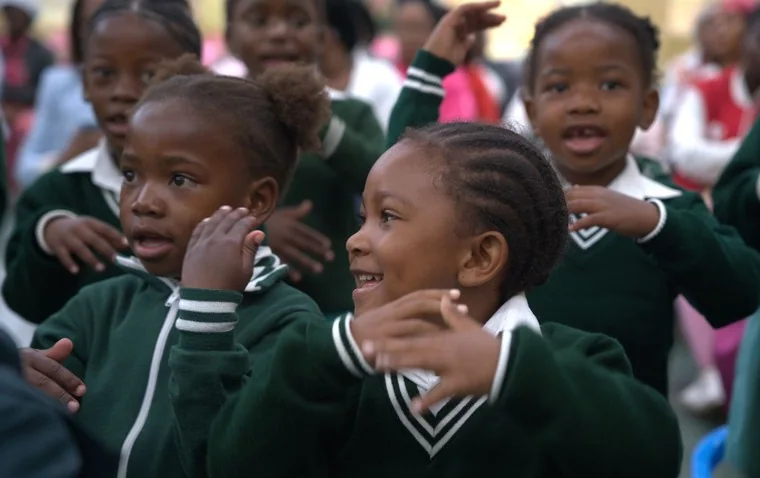
Every school day in Newcastle begins with prayer and a human value. Since 1998, children from Grade R to Grade 3 have learned here in English, and their parents say the change follows them home: into how the family talks, and even into church.
Help this school growFrom borrowed rooms to a school of its own
Newcastle opened in January 1998 with 75 learners in Grades R–3 and four staff, using rooms at St Oswald’s Secondary School. A campus of its own followed in 1999: six classrooms in the first phase, officially opened that April by Sri Indulal Shah, former International Chairperson of the Sathya Sai Organization, and Dr Art Ong Jumsai of the Institute of Sathya Sai Education in Thailand. An administration block and more classrooms were added in 2000.
In April 2026 the principal counted 112 learners. Many come from the townships of Madadeni and Osizweni. Many, she says, come from an informal settlement about 10 kilometres away, some from a location about 30 kilometres away, and many from homes with no formal income. Nearly all travel by transport their parents arrange themselves. In the schools near their homes, lessons are taught in isiZulu; here, English is the language of learning, and that is what families travel for.
Parents tell each other about the school. When neighbours see how the children speak and behave, they ask where they go to school.
A day that begins with values
Principal Hlengiwe Buthelezi arrives at half past six, before the teachers and the children. Learners sign in at quarter past seven. The day begins with fifteen minutes of prayer assembly in the hall and thirty minutes of Education in Human Values, or EHV. Each week the school takes one of the five values in turn: truth, right conduct, peace, love and non-violence. From Monday to Thursday each class explores the value, a sub-value and a quotation; on Friday every class presents its week in the hall, through music, stories and role plays.
Two EHV prefects in each class, a boy and a girl, are chosen each week from the best-behaved learners, so that every child wants to wear the badge. End-of-term certificates recognise them. Values also run through lessons in South Africa’s Curriculum and Assessment Policy Statement. On 14 February 2025, learners hung hearts on a Tree of Love and expressed its meaning through performances; the next day, parents joined a workshop on practising values at home.
The people behind the school
Chosen to be here
Hlengiwe Buthelezi did not set out to find this school. In her words, she was “chosen to be here.”
Hlengiwe Buthelezi
Principal · at the school since 2016, in her third year as principal in 2026
“I didn't choose the school but I was chosen to be here. Because I see the transformation that is happening in my life and to people that are around me.”
29 April 2026
After eighteen years in public schools, Buthelezi had resigned from the Department of Education. On the way to the shop one day she picked up a free newspaper and saw a post for a Foundation Phase teacher. She applied without knowing the school; a woman from her church knew where it was, because her child learned there. She joined in 2016, and within weeks began training in Education in Human Values.
The training changed her teaching, and her life. At a difficult time, she tried the silence sitting she had been taught. “Even though I am a Christian, I am praying at home. But I said let me call it silence sitting, let me do it as they trained me. It worked. I became calmed.” “This place transformed my life,” she says. Back in her Grade 1 classroom she began living the values in front of the children, and, she says proudly, it became the best class.
After several years teaching, she became principal. What keeps her, she says, is watching new teachers change: “So all this has kept me to this calling.” She counts the school’s director as a mentor, “like a mother” to her. She feels, she says, “a divine interaction” in the school: “I can see the progress when we take things and give all to him, all to God, things are starting to happen.”
Who is Sai Baba to Hlengiwe?
“What I like about him is he accepted all the faiths. All the faiths are acceptable as long as you are living the proper life. I also tell the people that he can change your life because of his teachings.”
29 April 2026Sri Sathya Sai Baba was an Indian spiritual teacher whose message of love and service inspired people around the world. His teachings centre on five human values (truth, right conduct, peace, love and non-violence), and every Sathya Sai school is built on them. Read our story
Children who change, and families who notice
Some parents bring children who have struggled at other schools. Buthelezi remembers a mother who came to her office worried about her son, who was about to start Grade 1. She did not know what to do, but she had heard the school helped children like him. The school enrolled him. “Within three months there was a change,” Buthelezi says. The mother wrote to thank the school: even at home, his behaviour had changed.
Parents come to her, she says, to tell her their children show the values in church and in how they speak to other people. In parenting workshops, families learn what the values mean and how to practise them at home. At one meeting, parents laughed as they told her the school was changing them too, “even how they are talking at home.” Parents attend in large numbers: 80 to 90 per cent of families come to school meetings, she says, and the records show it. Parents also join work-for-values gardening at the school.
Grade R has grown by word of mouth, she says. As she recalls it, Grade R had 14 learners “two or three years back”, then 39 “the year before last”, enough for two classes, and 29 in 2026. “The school is growing because the parents are happy about what we are doing.”
Learning worth celebrating
Friday spelling bees for every class from Grade R, Readathons and term-end certificates give children regular chances to practise and celebrate learning. Certificates recognise the top five performers each term. At the 28 November 2024 graduation and awards ceremony, Grades 1–3 were recognised alongside the Grade R graduates; during Readathon Week, children dressed as favourite book characters.
The school’s own report for Term 1 2025 records a 99% pass rate in its assessments of 108 learners; it is a school assessment, not a national examination. In April 2026, Buthelezi described the most recent term and the previous year in the same way: “99 point something.” Learning also takes practical forms: mathematics in everyday life and nature, songs and role plays about children’s rights, and a June 2025 career parade in which learners dressed for different professions.
When children move on after Grade 3, Buthelezi follows them. She asks families to send the certificates they earn and keeps them at the school. By her tracking, Newcastle’s former learners are always in the top ten of their new schools, even where a school has five Grade 4 classes. “It means that our education leaves no gaps even when the learners are not with us.”
Care that reaches home
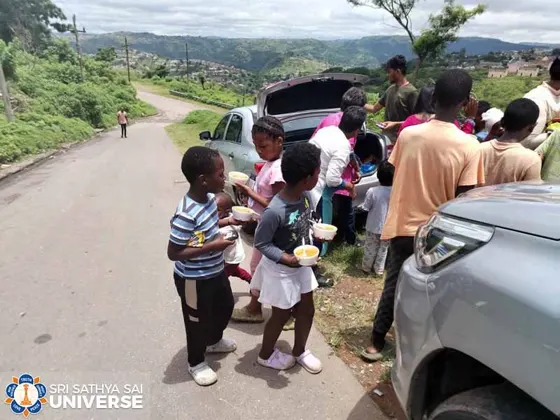
Every child receives a healthy lunch every school day, with vegetables such as spinach from the school garden. For children the school knows will have nothing to eat at home after school, it gives extra food. When teachers noticed children saying they felt sick, and it emerged that they had come without breakfast, the school began keeping porridge ready. Those children now know to come to the office first, eat, and then go to class.
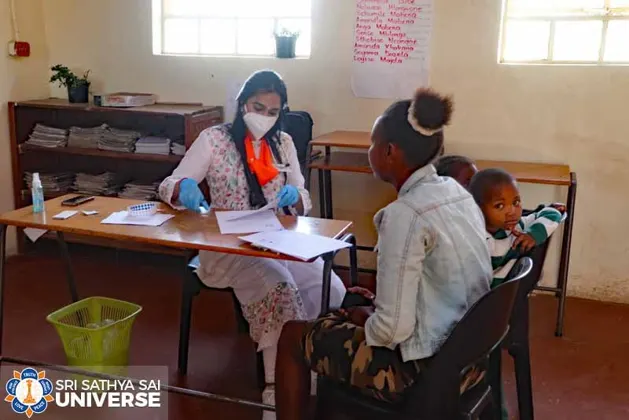
Families of Grade 3 leavers are invited to pass on uniforms that are still usable, for children whose own are worn out. Most parents are more at home in isiZulu than in English, so homework carries one worked example for each concept, and class WhatsApp groups let teachers explain tasks in isiZulu at set times. When a visiting medical team screened children’s eyes, children with problems were referred to hospital and some received glasses. One parent came to the school to thank it for the difference in her daughter’s sight.
Teachers living what they teach
A teacher who joined Newcastle in January 2016 described how staff development helped her integrate values into every subject: “I began to live by the values, walk and speak them…” Her published account links the example she set at school with her life at home.
Many teachers arrive new, some just out of college. Each begins with an induction on the school’s vision, then internal workshops and guided practice. Buthelezi spends much of her day in classrooms, showing new teachers how it is done. “I see them growing. Not at once, but gradually,” she says. Once a month she sits with each member of staff to see how they are; birthdays bring everyone together over tea and cake. The 2024 SSSIO education report names Newcastle among four schools whose principals and teachers completed a six-module introductory EHV course.
Teachers trained here often move on to public schools, she says, and take EHV with them. Former teachers phone her and send photographs, describing how they use the values with learners who behave badly, “because it's a new thing in those schools.”
Values beyond the school gates
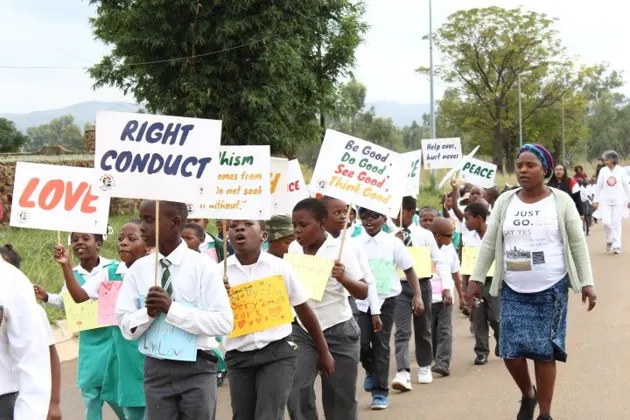
An earlier published SSSIO account tells of a mother whose daughter taught human values to neighbourhood children after school. They would wait for her to return and share what she had learned. On 10 May 2019, learners, families and teachers joined a peace walk through Lennoxton; another Walk for Values took place in September 2025.
On 9 August 2025, Newcastle hosted a Mother and Child Programme with SSSIO South Africa and the African Institute of Sathya Sai Education. Parenting activities, songs and drumming accompanied meals, vision screening by the African Eye Institute, dental examinations and hygiene talks. At the December 2025 sports day, children competed in houses named Love and Truth, with a token for every participant.
Newcastle now has what Buthelezi calls a sister school. The principal of a private school asked to bring her pupils for two hours to watch the EHV sessions from Grade R up, so that she could “unfold values” in her own school. When the school needed fresh paint and signage, she donated them. “She likes this school now.”
What support has made possible
By April 2026, the Sathya Sai Education Trust of South Africa had repaired the school’s broken roof gutters.
That term, Newcastle also received 22 computers. A parent who runs a computer shop is connecting them and charged very little, Buthelezi says, “because he liked the school.” Robotics was planned as a first use, with every learner using the computers at their own level. The 22 are Newcastle’s share of 44 computers given to Newcastle and Chatsworth together, as reported in October 2025.
What would help next
English is a new language for most of these children, and some have no television at home. For now, teachers can only show them pictures. Asked in April 2026 what would help most in the next three months, Buthelezi chose audio and visual teaching aids, televisions and audio equipment for the classrooms, so children can hear English stories and watch educational programmes.
The school also has about ten readers per class and no workbooks, so teachers photocopy and make their own. “It will be better if we can get more so that each and every child can hold their book,” she says. For children this young, holding a book and turning its pages is a skill too.
Her longer-term hopes are to keep children through Grade 4, so the values have more time to take root before they move to larger schools, and to open the new computers to the community, teaching skills that could help parents find work. To help Newcastle, contact the Schools Committee, which can confirm what is still needed and guide support through the Sathya Sai World Foundation.