Inside the school
Not just a school, but a home for transformation
In Jinja, 291 children from very poor families learn, eat and pray together. Sixty of them have lost both parents and study free. The people who run the school say they serve “not for salaries”, but for selfless service.
Help this school growA book in a library, a question in Singapore
In 2009 James Buyondo was teaching at a Ugandan school that Sai devotees in Singapore were helping. Among their gifts were spiritual books, and in the school library James found one about Sathya Sai Baba. The next year they sent two teachers from the school to study values-based education at the Sathya Sai institution in Thailand. “That is when Swami brought me in,” James says.
After the course, in Singapore, the couple asked the two teachers what they wanted to do for Uganda. James’s colleague said a school. James asked for a mobile clinic: a van with shelves of medicine, nurses and doctors, going to villages where people cannot afford a hospital. The couple said they would think about it when Swami permitted.
As James remembers it, the school was permitted in about 2016 and opened in 2017, when the donors came to inaugurate it and hand it to the community. In 2019 they asked James, by then Uganda’s coordinator for Education in Human Values, to connect them with the Sai Centre trustees in Kampala, and the school passed officially to the Sri Sathya Sai International Organization there. The school owns its land and its farm, both registered under a trust. Jinja lies east of Kampala, and the school serves an area where families are very poor. “Swami chose there because people there are so vulnerable,” James says.
A day of porridge, bhajans and the garden
Most of the 291 children, 175 girls and 116 boys in ten classes, are day pupils, aged 3 to 17. Some come from two or three kilometres away. Primary 7 pupils live at school while they prepare for national examinations: James put the number at 30 in October 2026. The boarders’ day starts with morning devotions at 6:30.
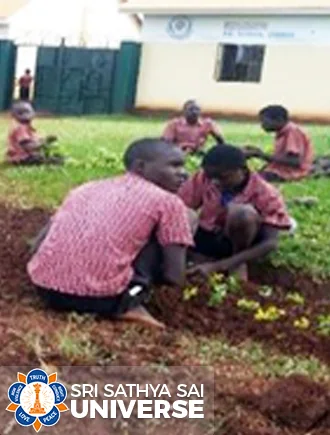
At 10:30 everyone has porridge, and at lunch posho, a maize-meal dish, with beans. Thursday is bhajan day, so lunch is beans and rice. Vegetables come from the school garden, and the food is vegetarian. Parents of the boarders, James says, “do testify that their children are very healthy.” Bhajans, or devotional songs, are practised in Tamil and in English, and parents are sometimes invited in to listen.
Families pay a small community contribution, so that they value what the school gives; James is clear that it is not a fee. Some parents bring food or work in the school garden instead. At weekends, pupils from Primary 4 to Primary 7 come in for extra lessons, and the boarders’ meals go on: one of the two cooks comes in, joined by the resident teachers and older children who help prepare the food. Between April and June 2025, children helped harvest maize and vegetables.
The people behind the school
Two roads to Jinja
James Buyondo and Simon Epasu run the school day to day. Both came to it through Sathya Sai Baba, by roads neither planned.
James Buyondo
Executive Manager · at the school Monday to Friday
“So I look at school as a valuable thing. For our country. For our motherland.”
23 October 2026
James found Sathya Sai Baba in a library book in 2009 and studied values-based education in Thailand the following year.
He joined the Sai family in Uganda in 2011 and was chosen as the country’s coordinator for Education in Human Values. By his own account he came fully into the school’s work at the 2019 handover, and moved to focus on it around 2020 or 2021. He oversees its daily running and links it to the Sai Centre in Kampala, then spends weekends in his work as a church administrator. “I am strongly supported by my faith in Swami,” he says.
Who is Sai Baba to James?
“The school’s director. All what we do was initiated and started by him.”
How James explains Sathya Sai Baba to parents · 23 October 2026Simon Epasu
Headmaster and maths teacher
“It’s my pleasure serving and transforming the lives of young and the community people.”
A written message to the Schools Committee · 23 October 2026
Simon comes from Kaberamaido, in the east of Uganda. James thinks he first met him around 2010, when Simon was working at the Sai Centre. “Swami is so amazing,” James says: from the Centre, Simon went on to university, earned a degree in education, and came “from the university straight away to school.” He now teaches maths and leads the school as headmaster.
This is Simon’s story as James tells it.
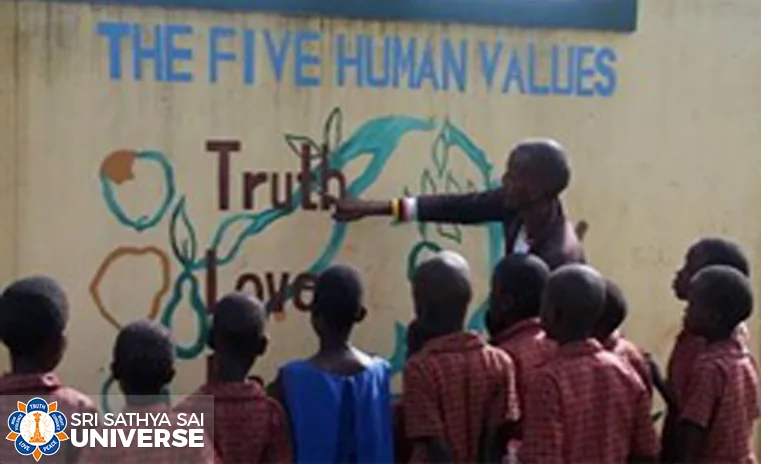
Sri Sathya Sai Baba was an Indian spiritual teacher whose message of love and service inspired people around the world. His teachings centre on five human values (truth, right conduct, peace, love and non-violence), and every Sathya Sai school is built on them. Read our story
A first grade in the values
This year, as the school dedicated its examination candidates, one of its first pupils came back to speak to them. She had been there “since day one”, when, James says, “nothing was in the school” and staff were “looking up to Swami and trusting Him.” Her exam grade was not the point, James says: she scored a first grade in the values.
In October 2026 she was in Senior 5, a year from finishing secondary school. James says that wherever she goes, people welcome her and help her because of her discipline and character. The school has recorded her story, and James plans to visit other former pupils to record theirs.
James also tells of a boy who struggled with his temper when he arrived. This year he is preparing for his national exams, and at the school’s awards he was named the best-behaved pupil. When a former pupil who finished Primary 7 in 2024 applied to a secondary school in Mbale, near the Kenyan border, that school had no place in Senior 1. James says it gave him one on the strength of the Sathya Sai school’s recommendation.
Values shared across faiths
Uganda is mostly Christian, and so are the school’s families. James is a church administrator at weekends. He explains that the school brings Sathya Sai Baba’s teachings and biblical teaching together around human values. “Our way is not here to deviate you from your ways,” he tells parents. “What we put focus on is the human values.”
In March 2025, a visiting pastor spoke with 200 pupils about Jesus as a role model and the values shared with Sathya Sai Baba’s teachings. On 23 November 2025, children from the Jinja school sang bhajans and presented a skit at the Sathya Sai Baba birthday celebrations in Uganda.
James says parents notice the change in teachers and children alike. One parent told him that if the community had only ten people of that character, it would change in the blink of an eye.
Leaders, elders and a whole community learning
In February 2025, 69 pupils joined a prefect leadership workshop based on Sathya Sai Baba’s teachings on leadership. An April workshop brought 90 pupils together for leadership skills and public speaking, and Primary 6 and 7 learners took part in the Sai 100 schools art competitions that August.
An Education Today profile published in October 2025 describes a Cultural and Goodness Day held on 23 July. Children, teachers and parents came in traditional attire, with dances and poems, and older pupils visited elders to learn about customs and family life, then honoured what those elders had given. The same profile describes parent and teacher meetings on the third Friday of the month, with classroom work and performances, a Walk for Values and tree planting. The 2025 education report adds parenting workshops in February, April, June and August, and community book-making in May and June.
In 2022, pupils and teachers cleaned the Mawoito health centre and supplied cleaning materials. In July 2025, medical experts from the York Forum held a health-education session for 120 pupils.
Teachers who stay, and teachers who come back
The school has 14 teachers, seven women and seven men. Most come from Jinja; others come from the far east and the west of Uganda. James says 60% of the teachers who started in 2017 are still serving. “We are a Sai family that eat together, pray together, and develop ourselves together.”
Teachers take part in regular training and refresher sessions in Education in Human Values. James posts the names of outstanding teachers on a notice board and gives them small tokens at the end of each term, and members of the trust have added tokens of their own.
When three teachers left at the end of 2025, all three came back for the first week of the new school year. James says they recommended colleagues to replace them and worked alongside them that week; after interviews, the newcomers joined the staff.
What support has made possible
The school runs mainly on donations from the Sai family in Uganda. Building projects have come from well-wishers further away. By October 2026, donors in Texas had funded teachers’ toilets and, as James recalls, a safe-water project: “School now has safe water. We pump our water,” James says. The Blackboard to Keyboard initiative brought 16 computers, and the school now has a fully furnished computer laboratory.
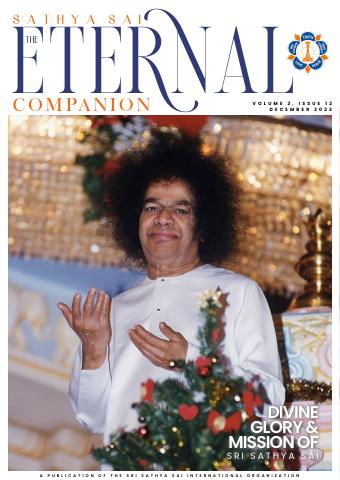
Care has also flowed the other way. During the March and April 2024 East Africa medical mission, the school grounds hosted a free medical camp, and staff and children helped. The July 2024 issue of The Eternal Companion records 1,003 patients at the Jinja camp. James, who once asked for a mobile clinic, called it “Swami combining two things”: the school’s work and health care.
Space for the next stage
The school’s first priority in October 2026 was a main hall that could also serve as an examination hall. Candidates now travel to other centres to sit their national exams; the school has asked to become an examination centre, which needs a hall. There is enough land, and an engineer was preparing a quotation.
James also named a fence to protect the grounds and the crops from intruders and animals, which a well-wisher in Singapore has already helped to fund; staff quarters near the school; a school van for children and teachers who travel far, especially in the rainy season; and better support to keep good teachers. As of October 2026 these were proposals, with most quotations still to come.
His longer hope is a Sathya Sai secondary school, so that older pupils can carry the values on to the younger ones. In the meantime, the school takes Education in Human Values programmes into two secondary schools that receive its leavers.
If you would like to support learning, meals or the next stage of the school’s development, the Schools Committee can explain what is currently needed and confirmed.